L-citrulline vs L-arginine for blood flow, explained by Club House Wood
L-citrulline and L-arginine are two of the most talked-about amino acids in men's circulation. They are close cousins that work in the same nitric oxide pathway, yet they behave differently in the body — and understanding that difference is the key to why so many formulas, including Club House Wood, choose to include both rather than pick one.
The short version, before the detail.
- L-arginine
- The direct building block the body converts into nitric oxide — fast, but much of an oral dose is broken down before it acts.
- L-citrulline
- Converted by the body into arginine, which can raise arginine levels more effectively and steadily than arginine taken alone.
- Together
- Pairing them supports both an immediate supply and a sustained one — the reason they are so often combined.
- In Club House Wood
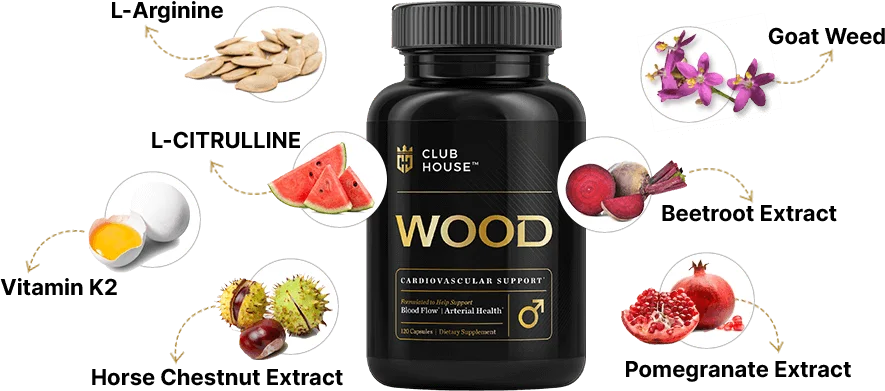
- Both are included, alongside beetroot and pomegranate, so the pathway is supported from more than one angle.
- Remember
- They support healthy blood flow within a normal range; they are not a treatment, and results vary.
If the last section sounds surprising — that the direct precursor might not be the more useful supplement — you are not alone. It is one of the more counter-intuitive findings in nutrition, and it is worth walking through slowly.
What is L-arginine?
L-arginine is a conditionally essential amino acid, which means your body usually makes enough but may benefit from more during certain stages or stresses of life. In the nitric oxide pathway it is the star of the show: an enzyme called nitric oxide synthase converts arginine directly into nitric oxide, the molecule that signals blood vessels to relax and widen. On paper, then, arginine looks like the obvious thing to supplement.
The catch with oral arginine
The complication is what happens between your mouth and your bloodstream. A large share of oral L-arginine is broken down in the gut and liver by an enzyme called arginase before it ever reaches general circulation. That first-pass loss means the amount that arrives where it is needed can be modest, and larger doses are more likely to cause digestive upset. Arginine still has its place — a meta-analysis of randomised placebo-controlled trials found oral L-arginine produced small average reductions in blood pressure (Dong et al., American Heart Journal, 2011) — but its delivery is inefficient.
What is L-citrulline?
L-citrulline is a non-protein amino acid named after the watermelon (Citrullus), a natural source. Its trick is elegant: rather than being used directly, the body converts citrulline into arginine in the kidneys, and it largely escapes the arginase breakdown that limits oral arginine. That is exactly what a controlled crossover study found: the same oral dose raised plasma arginine substantially more when given as citrulline than as arginine (Schwedhelm et al., British Journal of Clinical Pharmacology, 2008).
Why that matters
Because citrulline tops up arginine steadily and sidesteps first-pass loss, it tends to support the pathway more reliably over time. It is also generally gentle on the stomach at sensible amounts. For these reasons, many circulation-focused formulas lean on citrulline, or on a citrulline-plus-arginine pairing, rather than arginine alone.
| Feature | L-Arginine | L-Citrulline |
|---|---|---|
| Role in the pathway | Direct nitric oxide precursor | Converted into arginine first |
| Absorption | Much lost to first-pass breakdown | Escapes arginase; more efficient |
| Effect on blood arginine | Short-lived rise | Higher, steadier rise |
| Digestive tolerance | Can upset the stomach at higher doses | Generally well tolerated |
| Food sources | Nuts, seeds, poultry, legumes | Watermelon and other cucurbits |
See both amino acids in Club House Wood →
So which one should you choose?
For most men the honest answer is: you do not have to choose. The two amino acids are complementary, not competing. Arginine offers an immediate building block; citrulline keeps the arginine supply topped up. Using them together covers both ends of the pathway, which is exactly why they are so frequently paired in the same formula.
| If your priority is... | A sensible approach |
|---|---|
| Steady, everyday pathway support | Favour L-citrulline, or a citrulline-arginine pairing. |
| Simplicity in one daily routine | Choose a formula that already combines both, plus dietary nitrates. |
| Getting more from food first | Add watermelon, nuts, seeds and leafy greens, then top up if you wish. |
| Working around a sensitive stomach | Citrulline is usually the gentler of the two at sensible amounts. |
Club House Wood takes the combined approach. Each four-capsule serving supplies both L-arginine and L-citrulline, then adds beetroot for the dietary-nitrate route, a separate path to nitric oxide with its own human evidence (Webb et al., Hypertension, 2008) and pomegranate, horse chestnut, horny goat weed and vitamin K2 for broader circulatory support. If you want the underlying biology, our guide to nitric oxide and blood flow walks through the whole pathway, or see the full ingredients section.
Both amino acids, one daily step
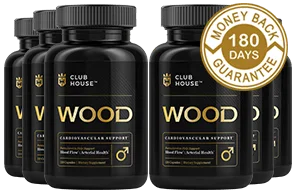
Club House Wood pairs L-arginine and L-citrulline with beetroot and pomegranate in four daily capsules. The six-bottle bundle is the best value at $49 per bottle, with free U.S. shipping and a 180-day guarantee.
Order Club House Wood — from $49/bottle
Can you get them from food?
Yes, and a food-first approach is always worth building on. Watermelon is the classic citrulline source — the rind holds even more than the flesh — while arginine is plentiful in nuts, seeds, poultry, fish and legumes. A varied, plant-rich diet contributes meaningfully to the pathway, and the wider food, movement and sleep habits behind it are set out in our guide to natural ways to support men's circulation. Supplements simply offer a convenient, consistent top-up on days when the diet is not perfect, which is most days for most people.
When should you talk to a doctor?
Amino acids that support blood flow are generally well tolerated, but they are not right for everyone. Because they can affect circulation, they may interact with blood-pressure medication, nitrates or erectile-dysfunction drugs. If you take any medication, have a cardiovascular or other medical condition, are under 18, or are preparing for surgery, speak with your doctor before starting. This article is educational and is not a substitute for professional medical advice.
Frequently asked questions
What is the difference between L-citrulline and L-arginine?
Both are amino acids in the nitric oxide pathway. L-arginine is the direct precursor the body converts into nitric oxide, while L-citrulline is converted by the body into L-arginine. Because citrulline sidesteps rapid breakdown, it can raise arginine levels more effectively than taking arginine itself.
Which is better for blood flow, citrulline or arginine?
Neither is a treatment, and results vary. Many formulators favour L-citrulline, or a citrulline-arginine pairing, because citrulline sustains arginine more reliably. Club House Wood includes both, so the two work together rather than forcing a choice.
Why do supplements pair citrulline and arginine together?
Pairing them covers both ends of the pathway: arginine supplies an immediate building block, while citrulline replenishes arginine over time. Using them together is a common, sensible approach in circulation-focused formulas.
Can I get citrulline and arginine from food?
Yes, in smaller amounts. Watermelon is a well-known source of citrulline, and arginine appears in nuts, seeds, poultry and legumes. A varied diet contributes to the pathway, and supplements are simply a convenient, consistent top-up.
Does Club House Wood contain both amino acids?
Yes. Club House Wood pairs L-arginine and L-citrulline with beetroot, pomegranate, horse chestnut, horny goat weed and vitamin K2, so the nitric oxide pathway is supported from more than one direction in four daily capsules.
Are there any cautions with these amino acids?
Because they support blood flow, they may interact with blood-pressure medication, nitrates or erectile-dysfunction drugs. If you take any medication, have a medical condition, are under 18, or are preparing for surgery, speak with your doctor before use.
Try Club House Wood risk-free for 180 days →
Club House Wood is a dietary supplement, not a treatment for any medical condition. These statements have not been evaluated by the Food and Drug Administration. This product is not intended to diagnose, treat, cure or prevent any disease. Always consult a qualified healthcare professional about your individual needs.
References & further reading
- Examine.com. Citrulline — evidence-based summary. examine.com/supplements/citrulline
- Examine.com. Arginine — evidence-based summary. examine.com/supplements/arginine
- National Institutes of Health, Office of Dietary Supplements. Dietary supplements for exercise and athletic performance. ods.od.nih.gov
- Schwedhelm E, et al. Pharmacokinetic and pharmacodynamic properties of oral L-citrulline and L-arginine: impact on nitric oxide metabolism. Br J Clin Pharmacol. 2008. PMID 17662090
- Dong JY, et al. Effect of oral L-arginine supplementation on blood pressure: a meta-analysis of randomized, double-blind, placebo-controlled trials. Am Heart J. 2011. PMID 22137067
- Webb AJ, et al. Acute blood pressure lowering, vasoprotective, and antiplatelet properties of dietary nitrate via bioconversion to nitrite. Hypertension. 2008. PMID 18250365
- Bailey SJ, et al. Dietary nitrate supplementation reduces the O2 cost of low-intensity exercise and enhances tolerance to high-intensity exercise in humans. J Appl Physiol. 2009. PMID 19661447
These references describe the ingredients in general terms and do not constitute evidence that any product treats, cures or prevents any condition.
Keep reading: nitric oxide and blood flow · natural ways to support men's circulation · back to the Club House Wood blog · homepage.