Nitric oxide and blood flow: the Club House Wood guide
Nitric oxide is one of the most important molecules you have never thought about. Your body makes it in the thin lining of your blood vessels, and its job is simple but essential: to signal those vessels to relax and widen so blood can move freely. This guide explains what nitric oxide is, why it matters for men as the years add up, how the body makes it, and where the ingredients in Club House Wood fit into a heart-smart routine.
The fast version, in one place.
- What it is
- Nitric oxide is a signalling molecule made in the vessel lining that tells blood vessels to relax and widen.
- Why it matters
- Wider, more responsive vessels mean easier blood flow, which supports stamina, circulation and everyday cardiovascular wellness.
- How it is made
- Two routes: from the amino acid L-arginine (sustained by L-citrulline), and from dietary nitrates in foods such as beetroot.
- How to support it
- Nitrate-rich vegetables, regular movement, good sleep, and, if you choose, well-studied nutrients like L-citrulline and beetroot.
- Timeframe
- A single nitrate-rich meal can help the same day; broader habits show over weeks to months, and results vary.
If you have noticed that easy energy takes a little more effort than it used to, circulation is part of that story. For most men the aim is not a dramatic intervention — it is simply steadier ground. The good news is that the nitric oxide pathway responds to ordinary, repeatable habits.
What is nitric oxide?
Nitric oxide (chemical shorthand NO) is a gas your body produces on demand. It is made largely by the endothelium — the single-cell-thick lining that coats the inside of every blood vessel. When the endothelium releases nitric oxide, it diffuses into the surrounding smooth muscle and prompts it to relax. That relaxation is called vasodilation, and it is how vessels widen to let more blood through. Because nitric oxide is so short-lived, the body has to keep making it, which is why the raw materials and habits that feed the pathway matter day after day.
Why does blood flow matter for men?
Blood is the delivery service for everything your tissues need: oxygen, nutrients and the removal of waste. When vessels are flexible and responsive, that delivery is smooth and efficient. Healthy circulation underpins physical stamina, exercise recovery, and the everyday sense of vitality that many men associate with feeling their age or feeling younger than it.
What changes with age?
Two things tend to happen as men move through their forties and beyond. First, the endothelium can become less responsive, so it produces less nitric oxide in response to the usual signals — a well-documented feature of vascular ageing (Seals et al., Clinical Science, 2011). Second, lifestyle factors — a desk-bound day, uneven sleep, stress and dietary shortcuts — pull in the same direction. None of this is destiny. It simply means the pathway benefits from a little intentional support.
How does the body make nitric oxide?
There are two complementary routes, and a good routine supports both.
| Route | Starting material | How it works |
|---|---|---|
| Arginine route | L-arginine amino acid | An enzyme (nitric oxide synthase) converts L-arginine into nitric oxide; L-citrulline is recycled back into arginine to keep the supply going. |
| Nitrate route | Dietary nitrates (e.g. beetroot) | Nitrate from vegetables is reduced to nitrite by mouth bacteria, then to nitric oxide in the body, especially when oxygen is low. |
The arginine route
L-arginine is the direct building block the body turns into nitric oxide. The catch is that arginine taken on its own is largely broken down before it can do much. That is where L-citrulline earns its place: the body converts citrulline efficiently into arginine, which can raise and sustain arginine levels more reliably than arginine alone. In a controlled crossover study, an oral dose of L-citrulline raised plasma arginine more than the same dose of arginine itself (Schwedhelm et al., British Journal of Clinical Pharmacology, 2008). It is a neat piece of biochemistry, and the reason the two are so often formulated together.
The nitrate route
The second route bypasses the enzyme entirely. Nitrate-rich vegetables — beetroot above all, plus rocket, spinach and other leafy greens — provide nitrates that friendly bacteria in the mouth convert into nitrite, which the body then turns into nitric oxide. That conversion is not theoretical: dietary nitrate has been shown to raise circulating nitrite and produce measurable vascular effects in humans (Webb et al., Hypertension, 2008), and nitrate supplementation lowered the oxygen cost of submaximal exercise in a controlled trial (Bailey et al., Journal of Applied Physiology, 2009). This is why beetroot juice is a favourite of endurance athletes before a race.
See how Club House Wood supports the pathway →
Which nutrients are part of the conversation?
Supplements are a supplement to good habits, not a substitute, and never a treatment for any condition. Still, a handful of nutrients are consistently part of the nitric oxide and blood flow conversation, several of which appear in Club House Wood.
| Nutrient | Why it is discussed | General role |
|---|---|---|
| L-arginine | Nitric oxide precursor | The direct building block the body converts into nitric oxide. |
| L-citrulline | Arginine booster | Recycled into arginine, helping sustain the pathway more steadily than arginine alone. |
| Beetroot | Dietary nitrate | One of the richest food sources of nitrate, feeding the nitrate route to nitric oxide. |
| Pomegranate | Polyphenols | Antioxidant compounds studied for general vascular and metabolic wellness. |
| Vitamin K2 | Calcium handling | Involved in directing calcium in the body; often included for arterial wellness. |
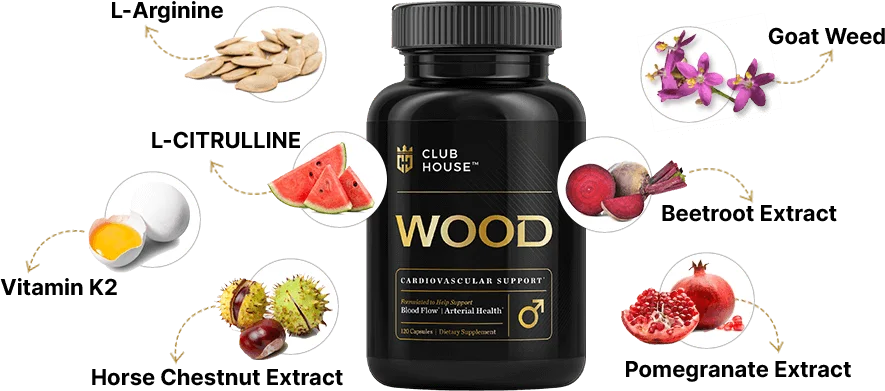
Club House Wood brings these together: L-arginine and L-citrulline for the arginine route, beetroot for the nitrate route, and pomegranate, horse chestnut, horny goat weed and vitamin K2 for broader circulatory support — as four daily capsules rather than a drink. For a closer look at the amino acids, read our comparison of L-citrulline versus L-arginine, or see the full ingredients section.
Make it a daily habit
Club House Wood is a once-daily, four-capsule formula pairing L-arginine and L-citrulline with beetroot and pomegranate. The six-bottle bundle is the best value at $49 per bottle, with free U.S. shipping and a 180-day guarantee.
Order Club House Wood — from $49/bottleHow can you support nitric oxide naturally?
The pathway responds to the same everyday habits that support the rest of your cardiovascular system, which we cover in more depth in our guide to natural ways to support men's circulation. Stack them one at a time until each feels automatic:
- Eat nitrate-rich vegetables — beetroot, rocket, spinach and other leafy greens most days.
- Move regularly — even brisk walking prompts the endothelium to release more nitric oxide, and repeated exercise is the best-characterised stimulus for vascular adaptation (Green et al., Physiological Reviews, 2017).
- Protect your sleep — seven to nine hours supports the vessel lining and steadier numbers.
- Consider well-studied nutrients — L-citrulline and beetroot are the best known for the pathway.
When should you talk to a doctor?
Supporting nitric oxide naturally is for healthy circulation already within a normal range; it is not a replacement for medical care. Because nutrients that support blood flow can interact with certain medicines, speak with your doctor before starting if you take blood-pressure medication, nitrates or blood thinners, have a cardiovascular or other medical condition, are under 18, or are preparing for surgery. A quick conversation makes sure anything you add fits safely with your care.
Frequently asked questions
What is nitric oxide and what does it do?
Nitric oxide is a short-lived signalling molecule your body makes in the lining of the blood vessels. It tells the smooth muscle in vessel walls to relax, which lets the vessels widen so blood can move more freely. That process is central to healthy, everyday blood flow.
Why does nitric oxide matter more for men over 40?
The body's natural production of nitric oxide tends to taper with age, and the vessel lining can become less responsive. Supporting the pathway through diet, exercise and, if you choose, well-studied nutrients is one way men aim to keep circulation on steadier ground.
How does the body make nitric oxide?
There are two main routes. In the arginine route, the amino acid L-arginine is converted into nitric oxide by an enzyme, and L-citrulline is recycled back into arginine to sustain it. In the nitrate route, dietary nitrates from foods like beetroot are converted into nitric oxide by mouth bacteria and body tissues.
Which foods and nutrients support nitric oxide?
Nitrate-rich vegetables such as beetroot and leafy greens, plus the amino acids L-arginine and L-citrulline, are the best-known contributors. Polyphenol-rich foods like pomegranate are also part of the conversation for general vascular wellness.
Does Club House Wood boost nitric oxide?
Club House Wood supplies L-arginine, L-citrulline and beetroot, the nutrients the body uses in the nitric oxide pathway, alongside pomegranate, horse chestnut, horny goat weed and vitamin K2. It is designed to support the body's own blood flow, not to force it, and is not a treatment for any condition.
How long does it take to notice a difference?
A single nitrate-rich meal or dose can raise nitric oxide the same day, while broader changes from consistent diet, exercise and supplement habits usually show over several weeks to a few months. Individual results vary.
Try Club House Wood risk-free for 180 days →
Club House Wood is a dietary supplement, not a treatment for any medical condition. These statements have not been evaluated by the Food and Drug Administration. This product is not intended to diagnose, treat, cure or prevent any disease. Always consult a qualified healthcare professional about your individual needs.
References & further reading
- Examine.com. Citrulline — evidence-based summary. examine.com/supplements/citrulline
- Examine.com. Nitrate (including beetroot). examine.com/supplements/nitrate
- Examine.com. Arginine. examine.com/supplements/arginine
- National Center for Complementary and Integrative Health (NCCIH). Horse Chestnut. nccih.nih.gov/health/horse-chestnut
- Webb AJ, et al. Acute blood pressure lowering, vasoprotective, and antiplatelet properties of dietary nitrate via bioconversion to nitrite. Hypertension. 2008. PMID 18250365
- Bailey SJ, et al. Dietary nitrate supplementation reduces the O2 cost of low-intensity exercise and enhances tolerance to high-intensity exercise in humans. J Appl Physiol. 2009. PMID 19661447
- Schwedhelm E, et al. Pharmacokinetic and pharmacodynamic properties of oral L-citrulline and L-arginine: impact on nitric oxide metabolism. Br J Clin Pharmacol. 2008. PMID 17662090
- Green DJ, et al. Vascular adaptation to exercise in humans: role of hemodynamic stimuli. Physiol Rev. 2017. PMID 28151424
- Seals DR, Jablonski KL, Donato AJ. Aging and vascular endothelial function in humans. Clin Sci (Lond). 2011. PMID 21244363
These references describe the ingredients and pathway in general terms and do not constitute evidence that any product treats, cures or prevents any condition.
Keep reading: L-citrulline vs L-arginine for blood flow · natural ways to support men's circulation · back to the Club House Wood blog · homepage.